
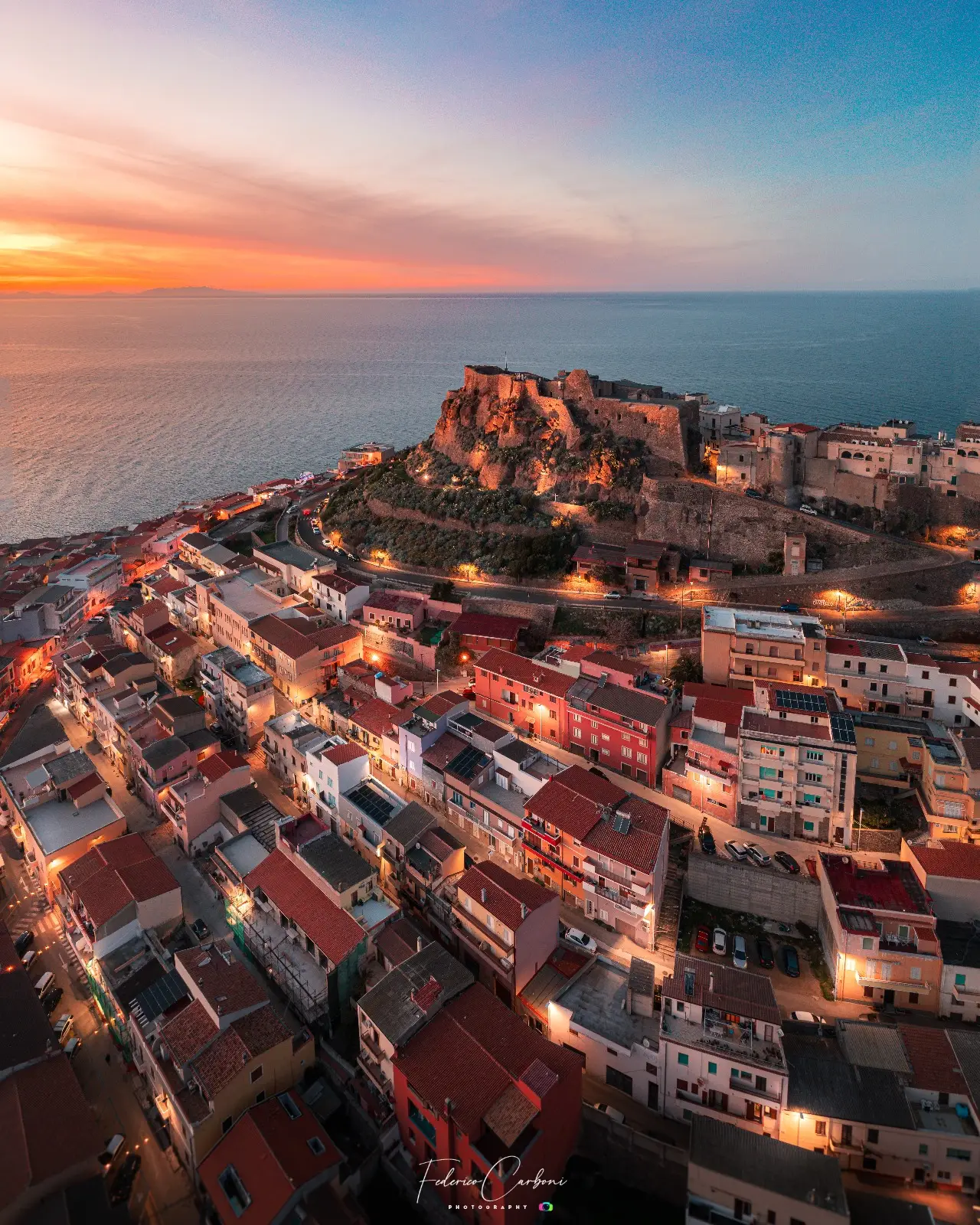
“Castelsardo is the village that, more than any other in Sardinia, gives the impression of having been built purely to be beautiful. The truth is it was built to be impregnable — and the beauty came all by itself.”
Castelsardo: Basketry Museum · Doria Castle · Cristo Nero · Lunissanti
Castelsardo began as a fortress of the Genoese Doria family, founded according to tradition in 1102: first Castel Genovese, then Castel Aragonese after the Aragonese conquest of 1448, and finally Castelsardo in the 18th century, under the House of Savoy. The castle that towers over the village from the top of the headland now houses the Museum of Mediterranean Basketry, and from its terrace you get one of the finest views in northern Sardinia: the Gulf of Asinara, Asinara itself and, on clear days, Corsica. In summer the village fills up from the afternoon onwards — for the sunset, get there by 18:30.
Castelsardo is also perfect as a starting point for boat trips along the coast of the Gulf of Asinara — wild coves you can only reach by sea. And about 4 km from the village is the Roccia dell'Elefante, with Domus de Janas (prehistoric rock-cut tombs) carved into its base: since 2025 it has been part of the “Domus de Janas” UNESCO site.
→ Find out where to stay near the village
An unusual museum devoted to the art of traditional basket-making, in the rooms of Doria Castle. Baskets, corbule (large Sardinian baskets) and flat baskets in asphodel, dwarf palm, rush and other plant fibres, from Castelsardo and from all over the Mediterranean.
With its walls, the medieval castle tells the story of Castelsardo, from its Genoese founding to the Aragonese and Savoy eras; you visit it with the same ticket as the Basketry Museum. From the terrace: views over the Gulf of Asinara, Asinara Island and Corsica.
The cathedral of the old village, perched above the sea, holds the altarpiece (retablo) by the Master of Castelsardo (late 15th century). The Cristo Nero (Black Christ), one of the oldest crucifixes in Sardinia, is kept in the nearby Church of Santa Maria instead, where the Lunissanti (Holy Monday) rites begin.
The lanes of the medieval village are an open-air museum in themselves. In many workshops the basket weavers work on their doorsteps: you can often watch them weaving asphodel and buy directly from them.
Holiday homes in Castelsardo
We have managed holiday homes in northern Sardinia since 2011. Book direct: save up to 15%, genuine local support, zero commissions.