
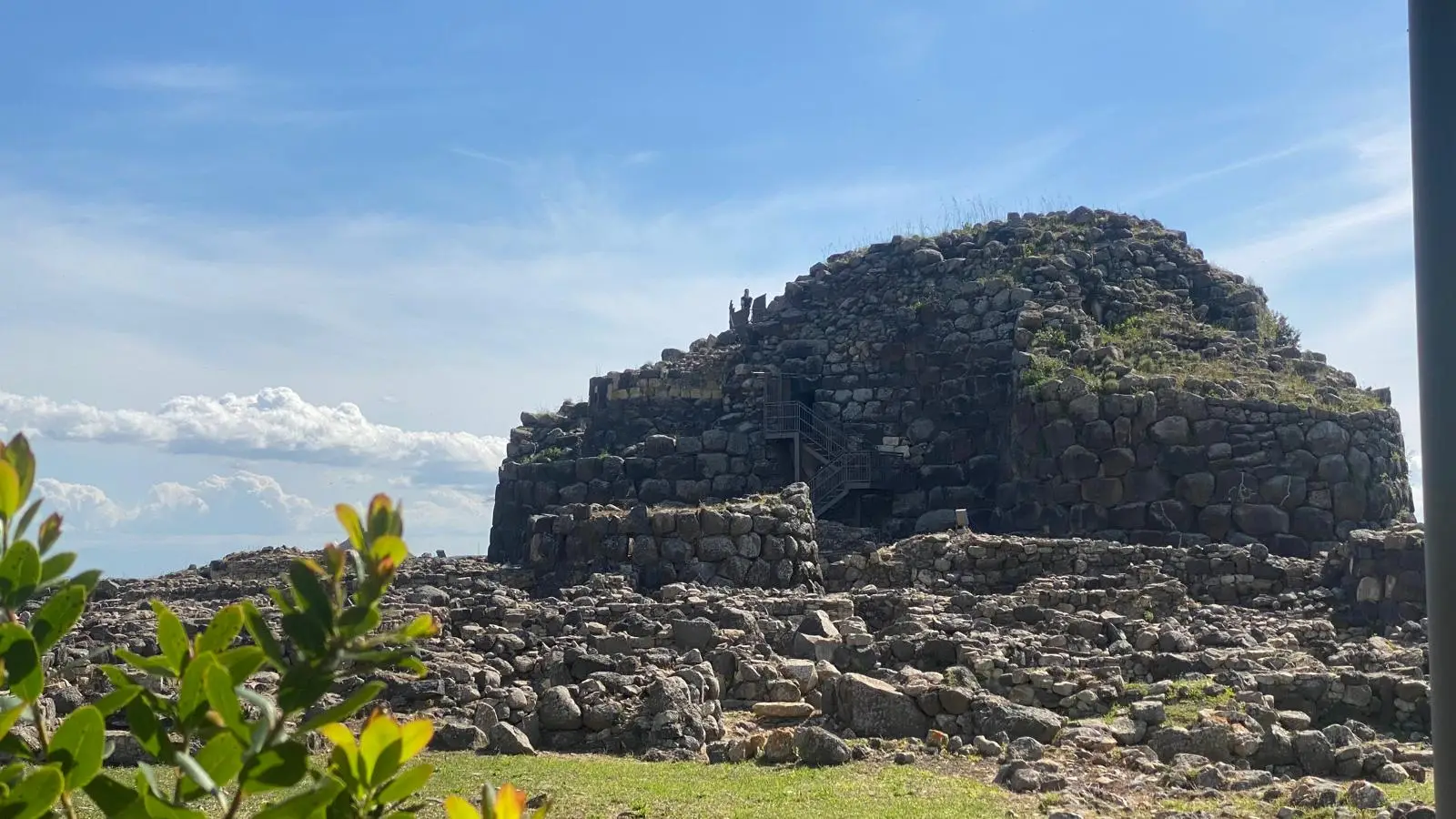
A nuraghe is a truncated-cone stone tower built in Sardinia by the Nuragic civilisation during the Bronze Age, for most scholars between 1800 and 1100 BC. According to scholars' estimates, between 7,000 and 8,000 have been identified in Sardinia, and originally more than 10,000 may have been built.
Northern Sardinia is home to some of the most spectacular and best-preserved ones: from the “palace” of Santu Antine in the Valle dei Nuraghi to the village of Palmavera, a stone's throw from the sea at Alghero, and on to the Arzachena archaeological park, a few minutes from the Costa Smeralda. Here you'll find the sites worth seeing, with distances from the places where you can stay, a 1–2 day itinerary and the tips we have been giving our guests since 2011.
Approximate road distances from the centre of the nearest town. Opening times and tickets change with the seasons: always check the official website before you set off.
Where: Torralba, in the Meilogu, on the Cabu Abbas plain, at the heart of the so-called Valle dei Nuraghi, where more than 30 nuraghi can be counted.
What to see: it is the emblem nuraghe of the north of the island, called Sa domo de su re, “the king's house”. The central tower (keep) originally stood more than 25 metres tall; about 17.5 remain today. Around it are three side towers joined by a curtain wall on a triangular plan, interior corridors you can walk through, stairs leading to the upper floors and the remains of the village. Excavations in 2007 dated the central tower to about 1800 BC.
Distance: about 55 km (an hour) from Alghero, about 63 km from Porto Torres.
Info: check opening times and tickets on the official website (nuraghesantuantine.it).
Where: along the SS127bis, about a kilometre from the sea at Fertilia and Porto Conte.
What to see: a complex nuraghe with two towers (the older one in limestone, from the 15th–14th century BC, the more recent one in sandstone) surrounded by a village of about 50 huts (originally an estimated 150–200). The highlight is the meeting hut: a stone bench runs along the entire wall, with the chief's seat and, in the centre, a sandstone model of a nuraghe (the original is in the Sanna Museum in Sassari; here there is a copy).
Distance: about 11 km (15–20 minutes) from the centre of Alghero.
Info: check opening times and tickets on the official website (nuraghepalmavera.it).
Where: in the Nurra, about 11 km from Sassari along the old SS131 towards Porto Torres.
What to see: it is not a nuraghe but it is older: a large terraced altar with an access ramp, often compared to Mesopotamian ziggurats and considered unique in Europe. The first phase, the “Red Temple”, dates to the Late Neolithic (about 3500–2900 BC, Ozieri culture); around 2800 BC it was buried and covered by a new stepped platform. The ramp is about 40 metres long; beside it stand a menhir of about 4.5 metres and a large spherical boulder.
Distance: about 9 km (12 minutes) from Porto Torres, about 36 km from Stintino.
Info: check opening times and tickets on the official website.
Where: about 2.5 km from Arzachena, on the road to Olbia: signposted car park, and the nuraghe is reached through a pedestrian underpass.
What to see: a “corridor” nuraghe (protonuraghe) built against a large granite outcrop that forms part of the masonry itself, hence the irregular plan. Inside is a large elliptical chamber with a tholos roof; around it, the remains of the village of circular huts. 80 metres away is the Moru giants' tomb.
Distance: about 10 km from Cannigione, about 16 km from Palau.
Where: just over 2 km from Arzachena, close to Albucciu: the two are easily combined in the same morning.
What to see: a small megaron-style temple from the Middle Bronze Age (16th–14th century BC), with a vestibule and a chamber of about 8 metres, seats along the walls, niches and a ritual hearth in the centre. It is older than the other Sardinian megaron temples, generally dated to the 12th–9th century BC.
Distance: about 10 km from Cannigione.
Where: in the Capichera valley, about ten minutes from Arzachena. The two sites are about 700 metres apart.
What to see: La Prisgiona is a nuraghe with a central tower and two side towers, in use from the 14th to the 8th century BC, with a village of almost 100 huts over about five hectares. Don't miss the entrance lintel (about 3 metres, about 7 tonnes) and the well in the courtyard, 7 metres deep and still working. Traces of wine from the excavations suggest viticulture more than 3,000 years ago.
Coddu Vecchiu is a granite giants' tomb: the central stele, about 4 metres tall, is indicated by Sardegna Turismo as the tallest on the island. Behind the exedra is the burial chamber, about 9 metres long.
Distance: about 11 km (a quarter of an hour) from Cannigione.
Where: on a hill about 7 km west of the centre of Arzachena.
What to see: a stele just under 4 metres tall and almost 2.5 wide, with an exedra of 14 granite slabs. The oldest part dates to the Early Bronze Age (19th–17th century BC), the corridor to the Middle Bronze Age. Total length: about 27 metres.
Arzachena park info: Albucciu, Malchittu, La Prisgiona, Coddu Vecchiu, Li Lolghi and the Li Muri necropolis are part of the Arzachena archaeological park: check opening times and combined tickets on the official website (gesecoarzachena.it).
Where: less than 2 km from the centre of Tempio, on the SS133 towards Palau, on a granite knoll at about 500 metres above sea level.
What to see: a single-tower nuraghe from the Middle–Late Bronze Age (16th–12th century BC) with mixed features between a protonuraghe and a tholos nuraghe: an entrance corridor of about 10 metres, a courtyard, two ovoid rooms and a panoramic terrace over the valley. In one of the rooms lives a colony of bats, among the smallest in the world, present from mid-April to October: no flash.
Distance: about 50 km (50 minutes) from Palau, about 50 km from Castelsardo.
Where: about 10 km from Buddusò, along the SS389 towards Bitti, about fifty metres from the road.
What to see: a “mixed” nuraghe with a central tower and a trilobate bastion, stairs climbing to the third level and traces of a village. About 100 metres away is a giants' tomb whose corridor and exedra are still readable.
Distance: about an hour's drive from Orosei.
Info: access arrangements to be checked with the Municipality of Buddusò.
Where: in the locality of Poddi Arvu, in a wood near the sources of the Tirso, 13 km from Bitti (SS389).
What to see: a village-sanctuary of about seven hectares, built entirely of granite: about a hundred huts, a well temple connected by a channel of more than 40 metres to a circular basin with amphitheatre-style steps, two megaron temples, one rectangular, and a singular labyrinth of concentric walls. The well temple and the labyrinth are dated to the 13th–9th century BC.
Distance: about 40 km from Orosei to Bitti, plus 13 km to the site: allow about an hour.
Info: paid entry, limited parking; check opening times on the official website.
Where: on the Gollei plateau, about 10 km from Dorgali (SS125 and then SP38).
What to see: about 100 basalt huts grouped in blocks with lanes and small squares, two megaron temples within sacred enclosures and hut 49, probably intended for meetings. Inhabited from the Early Bronze Age to the Iron Age.
Distance: about 20 km from Cala Gonone, about 30 km from Orosei.
Info: paid entry; check opening times and tickets on the official website.
Outside the area: the Losa Nuraghe (Abbasanta) is in the province of Oristano, while Su Nuraxi di Barumini is in south-central Sardinia.
Since 12 July 2025, “The funerary tradition in the prehistory of Sardinia – The domus de janas” has been a UNESCO World Heritage Site. The domus de janas (“fairy houses”) are rock-cut tombs, older than the nuraghi: they are pre-Nuragic, mostly from the Late Neolithic. The serial site includes 17 necropolises; three are in northern Sardinia and easy to reach:
Remember: Su Nuraxi di Barumini, a UNESCO World Heritage Site since 1997, is the only nuraghe on the list but it lies in the south-centre of the island, outside our area.
If you're on the east coast (Cala Gonone, Orosei): Serra Orrios in the morning, Su Romanzesu and Loelle Nuraghe on the same day, with lunch in Bitti or Buddusò.
AffittaSardegna has managed holiday homes in northern Sardinia since 2011, with its base in Porto Torres. Book directly on our website and save up to 15%. For advice on which home to choose based on your itinerary, message us on WhatsApp at +39 079 412 5245.
The Santu Antine Nuraghe in Torralba is the most imposing in the north: the central tower still stands about 17.5 metres high. To see a village as well, combine it with Palmavera or La Prisgiona.
About 7,000 have been identified (8,000 according to other estimates); originally no fewer than 10,000 are thought to have been built.
The Palmavera Nuraghe is about 11 km from the centre, towards Porto Conte. Combine it with the UNESCO necropolis of Anghelu Ruju; Santu Antine is about an hour away.
The site not to be missed is the pre-Nuragic altar of Monte d’Accoddi, about 9 km from Porto Torres, together with the Su Crucifissu Mannu necropolis. Santu Antine is about an hour away.
The heart of it is the Arzachena archaeological park: Albucciu Nuraghe, Malchittu Temple, La Prisgiona, and the Coddu Vecchiu and Li Lolghi giants' tombs. In Tempio Pausania there is the Majori Nuraghe.
No, the domus de janas are rock-cut tombs, older than the nuraghi (largely from the Late Neolithic). Since 2025 they have been a UNESCO World Heritage Site; in northern Sardinia you can find them in Alghero, Porto Torres and Castelsardo.
📍 Geographic entities — Nuraghi of northern Sardinia: