
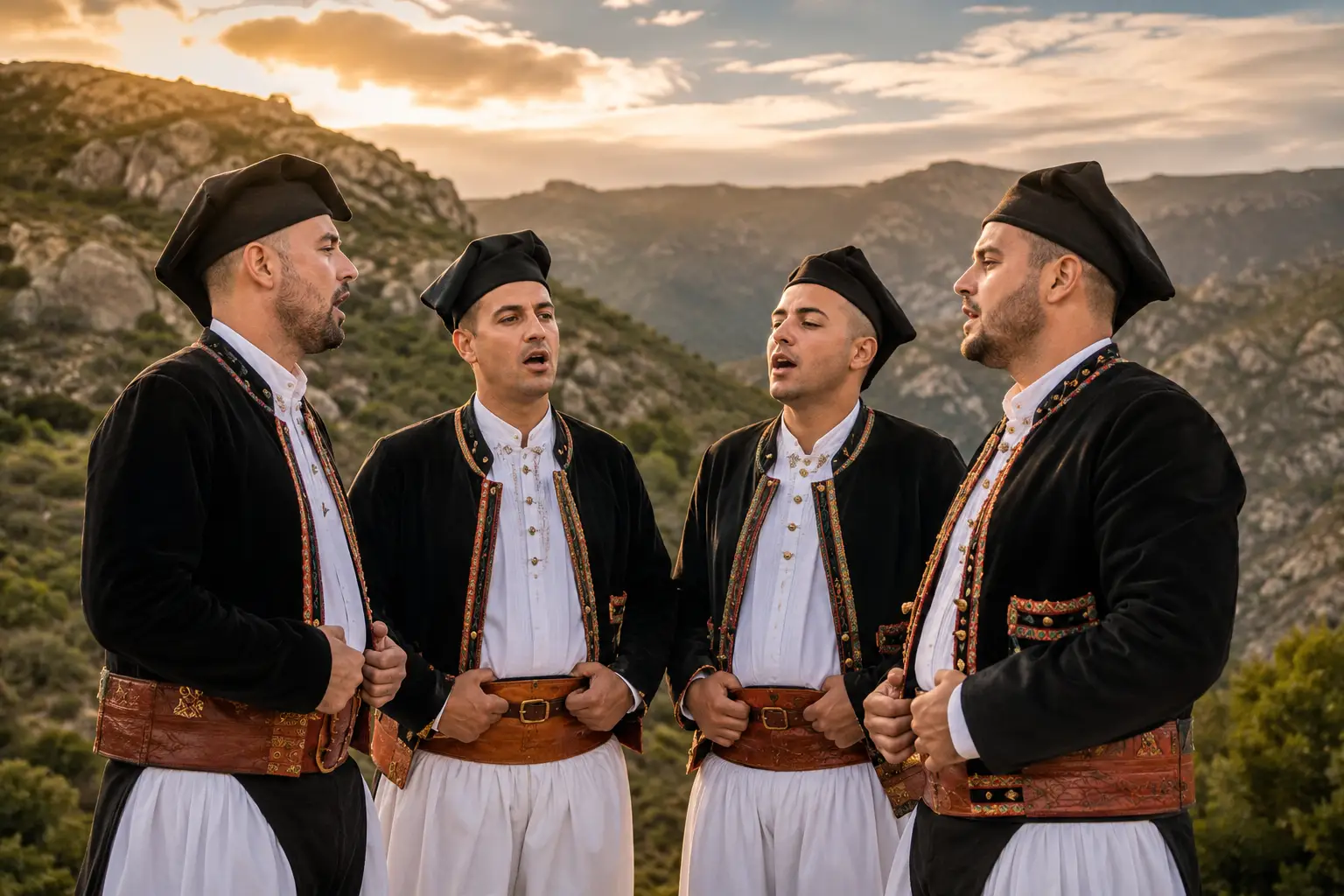
A group of Cantu a Tenore singers in traditional dress at the Barbagia festival in Sardinia

A group of Cantu a Tenore singers in traditional dress at the Barbagia festival in Sardinia

TRADITIONAL MUSIC — AFFITTASARDEGNA SINCE 2011

Traditional Sardinian Music:
Launeddas, Cantu a Tenore and the Sounding Barbagia

"The Cantu a Tenore is four voices that become one. It’s not harmony in the classical sense — it’s something older, that comes from before written music. The first time you hear it, something changes inside you."

Cantu a Tenore: UNESCO Intangible Cultural Heritage

The Cantu a Tenore is the male polyphonic singing typical of the Barbagia — recognised by UNESCO as Intangible Cultural Heritage of Humanity in 2005. It is a four-voice singing form (sa boche, sa mesu boche, sa contra, su bassu) that produces a unique harmony, with guttural and nasal resonances that exist in no other European musical tradition.

It is not learned in a conservatory — it is learned in dance halls and cellars, in the evening, among men who have known each other forever. It is a social, communal song that has survived centuries of foreign domination because it was preserved in the villages of the interior where no one arrived. Today it is still alive — and hearing it live in a courtyard of Oliena or Orgosolo is an experience found nowhere else.

The first time you hear the Cantu a Tenore live — not in a theatre, in a courtyard, with the singers drinking wine between pieces — you understand what music as a social act means. It is not a performance. It is a conversation.

The 2005 UNESCO Recognition

In 2005, UNESCO inscribed the Sardinian Cantu a Tenore on the List of Intangible Cultural Heritage of Humanity — the same list that includes Spanish flamenco and Japanese Noh theatre. The recognition specifically identified the Tenores of Oliena, Orgosolo, Bitti and Fonni as living custodians of the most authentic tradition.

  • Oliena — Tenores di Oliena, among the most recorded and internationally known
  • Bitti — Tenores di Bitti, the group that has contributed most to international recognition
  • Orgosolo — tradition more deeply rooted in folk song and narrative ballads
  • Fonni — one of the most vibrant centres of communal singing in the Barbagia

The Launeddas: The Oldest Wind Instrument in Europe

The Launeddas are a wind instrument composed of three reeds of different sizes — two reeds held together in the right hand, one in the left — played simultaneously using circular breathing (played without ever interrupting the sound, inhaling through the nose while blowing through the mouth). They are the oldest continuous wind instrument in Europe, depicted in Nuragic bronzes 2,800 years old.

The sound is hypnotic and continuous — a low melody and a drone that intertwine without pause. The Launeddas have always accompanied traditional Sardinian dances (sa dansa, su ballu) and religious ceremonies. Launeddas masters are few — a tradition at risk of extinction but one that still finds its natural audience at the Cortes Apertas.

Where to Hear Traditional Music in the Barbagia

Cortes Apertas — Live

During the Cortes Apertas, the Tenores perform in the squares and open courtyards of the villages. These are not scheduled concerts — they are spontaneous communal performances. Follow the sounds and the crowd.

Sa Die de sa Sardigna

On 28 April, the Festival of the Sardinian People, traditional dances with Launeddas and Fisarmonica animate the squares throughout the Barbagia. One of the most authentic occasions to see traditional costumes in real use.

Bitti — Music Museum

The Museum of Traditional Sardinian Music in Bitti holds instruments, recordings and documentation of the Cantu a Tenore. The Tenores di Bitti are the most internationally known group — check the concert calendar.

Parish Festivals

The parish festivals of the Barbagia villages always include traditional music and dancing. The September–October period is rich in local festivals — ask locally for updated programmes.

Other Instruments of the Sardinian Tradition

  • Fisarmonica — not traditional but adopted in the 1800s, today an integral part of Sardinian dances. The sound of the Fisarmonica with traditional costumes is the most common image of the Sardinian festival
  • Organetto diatonico — small button accordion, older and more rustic. Typical of less formal village festivals
  • Su sulitu — small reed or bone flute, used by shepherds to accompany solitary singing. Extremely rare to hear live today
  • Tamburello (su tamburinu) — frame drum used for dance rhythms. Often accompanies the Launeddas in performances

Want to plan a stay in Sardinia around a Cortes Apertas with music? Contact us — we know the calendars and the villages better than anyone.

🏠 Case a Cala Gonone
🔑 Are you a property owner?

FAQ — Traditional Sardinian Music

Is the Sardinian Cantu a Tenore really UNESCO heritage?
Yes, the Sardinian Cantu a Tenore was inscribed in 2005 on the UNESCO List of Intangible Cultural Heritage of Humanity. It is one of only two Italian intangible heritages recognised in that session. The recognition specifically identified the Tenores of Oliena, Orgosolo, Bitti and Fonni as living bearers of the tradition.

Where can you hear the Launeddas live?
The Launeddas can be heard live at the parish festivals of the villages of the Cagliaritano and the Nuorese (the most important masters are in southern Sardinia), during the Cortes Apertas in the Barbagia, and at some cultural events dedicated to traditional music. The Civic Museum of Cagliari holds a historic collection of Launeddas. The most renowned contemporary masters give concerts and workshops that can be followed on their social media channels.

What is the Ballu Sardo and how is it danced?
The Ballu Sardo (sa dansa or su ballu tundu) is the traditional Sardinian dance — a circular or line dance with hand or little finger holds between dancers, accompanied by Launeddas or Fisarmonica. The movements are sober, rhythmic, with an emphasis on the feet and upright body positions that reflect Sardinian pastoral culture. During the Cortes Apertas it is common to see costumed dancers dancing in the squares — one can often join in.

Categories

Beaches and Sea
What to Do
Traditions and Events
Food and Typical Products
Unique Experiences
Holiday Home Owners
Uncategorised
Routes and Family

Latest news from the blog

OUR SERVICES

Come for the stay, stay for the service

From listing your property to booking the ferry: with AffittaSardegna you have a single point of contact for everything.
Accommodation

More Articles