“In Alghero people still speak Algherese — a Catalan dialect that has survived 600 years far from Barcelona. When you walk its streets you feel that this place has stayed true to itself in a way few towns in the world manage.”
In 1353 the Crown of Aragon conquered Alghero and began a Catalan colonisation that would change the town's DNA for ever. The original inhabitants were expelled and replaced by Catalan settlers — from then on Alghero would speak Catalan, build in Catalan Gothic and keep an Iberian culture at the heart of the Sardinian Mediterranean.
Six hundred years later, Algherese still survives — Alghero is the only town in Italy where Catalan is still spoken. The walled old town, the Aragonese towers mirrored in the sea, Santa Maria Cathedral: every stone tells the story of this extraordinary historical anomaly.
In Alghero you walk in a city that has spoken Catalan for over 600 years. It is not a re-enactment — it is a language and a culture that are still alive.
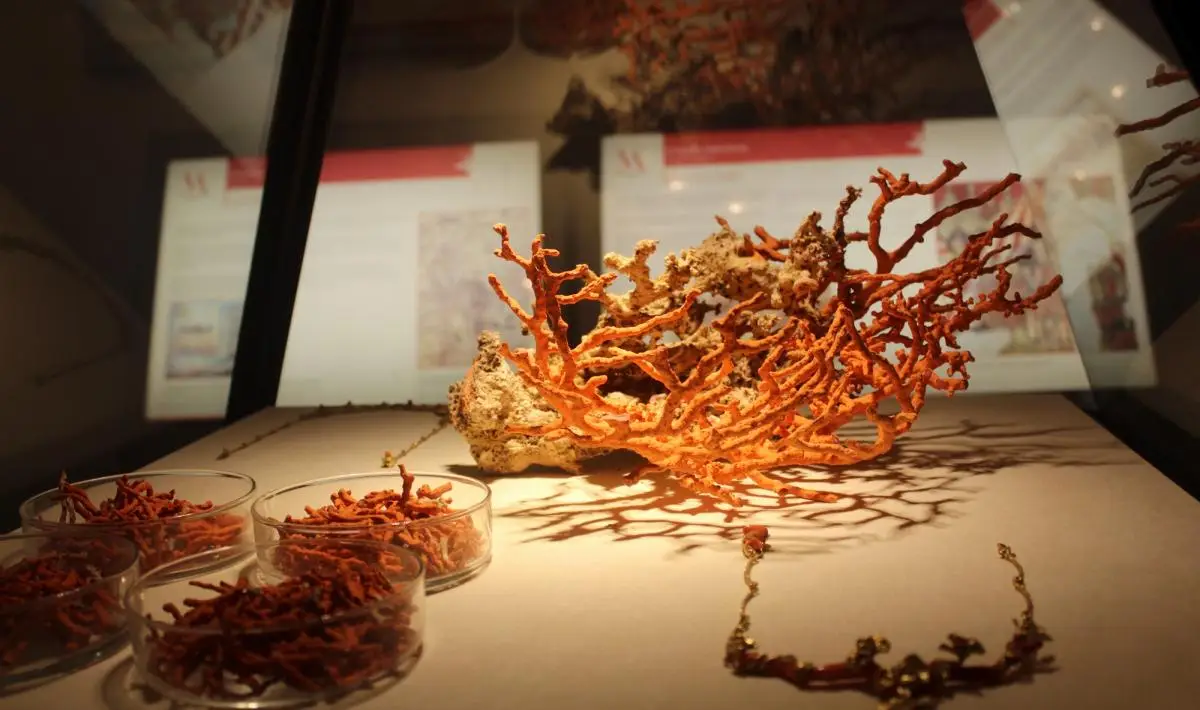
The red coral of the Mediterranean — Corallium rubrum — has in Alghero one of its historic capitals. The waters of the Riviera del Corallo, the stretch of coast between Alghero and Bosa, host some of the richest and most prized red coral colonies in the Mediterranean. For centuries Alghero has been one of the historic centres of fishing and craft working of this precious material.
Alghero's Coral Museum tells this story — from traditional harvesting to the coral fishermen's tools and the Sardinian coral jewellery that has come down through the centuries. A small, carefully curated museum in a 1927 Art Nouveau villa, with a scientific section on the life of coral and its protection.
The history and art of Mediterranean red coral — from traditional harvesting to handcrafted jewellery. Historic pieces of great value. A quick visit (45 min) but an unforgettable one. Information and opening times on museialghero.it.
Catalan Gothic with an Aragonese bell tower. Built between the 16th and 17th centuries, it mixes different styles: the neoclassical façade contrasts with the late Gothic interior.
It holds finds from the Alghero area, from the Neolithic to the Middle Ages, in three sections: the sea, dwelling and the sacred. Admission charge. Then, about 10 km from town, you can visit the Anghelu Ruju necropolis, part of the “Domus de Janas” UNESCO site since 2025.
The medieval Aragonese towers around the old town can be visited — some host seasonal exhibitions. The walkway along the sea walls offers one of the most beautiful views in northern Sardinia.
| Time | Stop | Notes |
|---|---|---|
| 09:00 | Old town — early morning, few crowds | Free stroll through the alleys |
| 10:00 | Santa Maria Cathedral | 30 mins |
| 10:30 | 🔴 Coral Museum (Museo del Corallo) | 45 min — not to be missed |
| 11:30 | Archaeological Museum (MUSA) | 60 min |
| 13:00 | Lunch in the old town — fresh fish | Better the inner alleys than the seafront |
| 15:00 | Aragonese towers and the walkway along the walls | Sea view |
| 16:30 | Neptune's Grotto (optional excursion) | About 45 min by boat from the port |
| 19:00 | Aperitivo on the ramparts | Sunset over the Gulf of Alghero |
Holiday homes in Alghero
We have managed holiday homes in northern Sardinia since 2011. Book direct: save up to 15%, genuine local support, zero commissions.