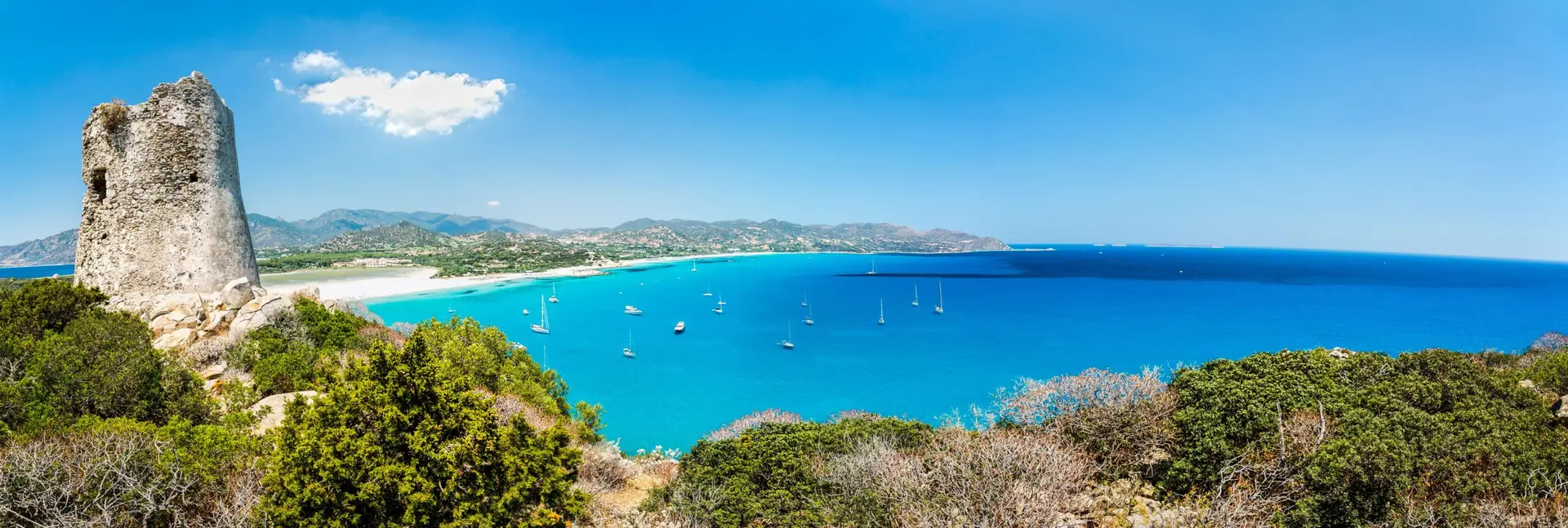
The coastal towers of Sardinia are the lookout and defence towers built all around the island's perimeter to spot Barbary pirate ships and raise the alarm before landings. Most of them were built between the late 16th and the 17th century, when Sardinia was part of the Spanish monarchy: it was Philip II who created the Royal Tower Administration, the body that built, armed and ran them for over two and a half centuries. According to a study by the University of Cagliari the system included 105 coastal towers and small forts. Each tower could see the next: with fires at night and smoke by day, the alarm travelled along the coast faster than any horse.
Today they are often the finest viewpoint on the beaches of northern Sardinia. Here you'll find the 10 towers really worth seeing between Capo Caccia and Santa Teresa di Gallura: where they are, what to expect and which ones you can go inside.
You'll hear almost every Sardinian tower called “Aragonese”. In most cases that's wrong. Here is the correct chronology:
So: the lookout towers of the 16th and 17th centuries are Spanish. “Aragonese” is correct only for 14th–15th-century structures, such as the tower in the port of Porto Torres (1325). It is no coincidence that museum sources note that the Isola Rossa tower is “often wrongly called an Aragonese tower”.
There were three types of tower. The “de armas” or “gagliarde” towers were the largest, armed with heavy-calibre cannons and manned by an alcaide (the commander), a gunner and a few soldiers. The “senzillas” were lightly defended. The “torrezillas”, the smallest, were used almost only for watching and signalling. The entrance was always raised, 4–6 metres above the ground, reached by rope or rung ladders that were pulled up in case of attack.
They're listed in geographical order, from west to east: it's also the order of the itinerary we suggest further down.
Where: on Punta del Bollo, at the entrance to Porto Conte bay, just north of Capo Caccia and above Cala Dragonara.
What to see: it is the sentinel closest to the cliffs of Capo Caccia, with a view of the bay and the headland. Nautical sources date it to 1591.
Open to visitors: it can be seen from the outside; there is no sign that the interior is open.
Where to stay: holiday homes in Alghero.
Where: on Porto Conte bay, about 30 metres from the sea, next to the lighthouse and near Maristella.
What to see: it is one of the largest coastal towers in Sardinia: 13 metres high and 18 in diameter at the base, in limestone, already mentioned in the Camos report of 1572. Antoine de Saint-Exupéry lived in Alghero, in a villa just above the tower, between spring and summer 1944, before disappearing in flight on 31 July.
Open to visitors: yes. It houses the Antoine de Saint-Exupéry Museum (MASE), for a fee, with different opening hours in low and high season: check the operator's website (Alghero Parks) before you go.
Where to stay: Alghero.
Where: in the Porticciolo (Portitxol) area, inside the Porto Conte Park and the Capo Caccia – Isola Piana Marine Protected Area.
What to see: already documented in 1572, it was built by the coral fishermen of Alghero to protect their boats. It has an unusual shape: a cylinder on a stepped truncated-cone base. Restored in 2009, it is the starting point of well-trodden coastal paths.
Open to visitors: it can be admired from the outside; opening of the interior is not confirmed.
Where to stay: Alghero.
Where: at the top of Capo Falcone, the far tip of the Nurra, almost 200 metres above the sea.
What to see: it is the highest tower in the Nurra and overlooks the Gulf of Asinara, Isola Piana and Asinara. Sources disagree on the exact date of construction, but the tower already appears on maps from the mid-16th century. It was a lookout and signalling tower, manned by two soldiers.
Open to visitors: you reach it on foot or by mountain bike and admire it from the outside; there are no visits inside and the crown needs consolidating.
Where to stay: holiday homes in Stintino.
Where: on a small island in front of La Pelosa beach, at the entrance to the Asinara strait, between Capo Falcone and Isola Piana.
What to see: one of the most photographed towers in Sardinia. Built of schist, 10 metres high with a base 16 metres in diameter, it was a heavily defended “de armas” tower. It already existed in 1578, when a viceroy's document notes the repairs it needed. The name comes from the beach, “Sa Palosa”.
Open to visitors: according to Sardegna Turismo you reach it on foot after crossing the cove of La Pelosetta; there are no visits inside. Note: in summer access to La Pelosa beach is limited and booking is compulsory, with an environmental contribution. You can only book on the official website spiaggialapelosa.it (in 2026: from 15 May to 15 October, 1,500 places a day, €3.50 per person).
Where to stay: Stintino.
Where: in the port of Porto Torres, near the archaeological area of Turris Libisonis.
What to see: this one really is Aragonese: it was built in 1325 by Admiral Francesco Carroz, right after the conquest. It served as defence and as a lighthouse, and gave the city its very name: “Porto Torres”, the port with the tower.
Open to visitors: no, not at the moment. According to the local press (2024–2025) it is in a state of serious decay and is passing from the State Property Office to the Municipality, which has started a redevelopment project. It can be seen well from the outside.
Where to stay: holiday homes in Porto Torres.
Where: on a rocky ledge at the end of Platamona beach on the Porto Torres side, about 4 km from the centre.
What to see: built in the 1570s in limestone, 12.5 metres high. It was a “signalling” tower: from here you could see the Isola Piana towers and, in clear weather, even the one at Isola Rossa. Restored in 2009 after years of storms.
Open to visitors: you can admire it from Platamona beach; there are no visits inside.
Where to stay: Platamona or Porto Torres.
Where: on a basalt rock at water level, below the old town of Castelsardo.
What to see: a small, slender tower (about 13 metres), dated to 1577 by the Touring Club guide. Photographed with the village and the Doria Castle behind it, it is one of the most beautiful postcards of the coast.
Open to visitors: it can be seen freely from the outside.
Where to stay: holiday homes in Castelsardo.
Where: on the hill overlooking the little harbour of Isola Rossa.
What to see: a Spanish tower built between 1578 and about 1595, with a cannon on top and room for five riflemen. From here you look over the port, the red islet that gives the village its name and the coast towards Costa Paradiso. At sunset the granite glows red.
Open to visitors: you can admire it from the outside, a stone's throw from the port; there are no regular openings of the interior.
Where to stay: holiday homes in Isola Rossa.
Where: on the headland between the bay of Santa Reparata and Porto Longone, above Rena Bianca beach.
What to see: it is the largest tower in Gallura: granite, 11 metres high and 19 in diameter at the base, a “de armas” tower commissioned by Philip II. First mentioned in 1577, it was renovated by the House of Savoy in the late 18th century. In 1802 it was occupied for a few days by the Sardinian-Corsican insurgents led by the priest Francesco Sanna Corda, who died at its foot.
Open to visitors: yes, it is open to visitors and hosts cultural events. Inside you find the casemate with a dome and central pillar and the stairs to the parade ground. Opening hours and tickets change with the season: check with the tourist office.
Where to stay: holiday homes in Santa Teresa di Gallura.
Bonus to see along the way: the Torre di Vignola (Aglientu), a granite “de armas” tower begun in 1605 to protect the tuna fishery, visible from the small harbour of Vignola Mare. If you also want to add the lighthouses, read our guide to the Lighthouses of Gallura.
The defence system numbered 105 towers and small coastal forts, according to a study by the University of Cagliari. Not all have survived to the present day: some are well restored, others are ruins.
Almost all are Spanish, built between the late 16th century and the 17th century under Philip II and his successors. “Aragonese” is only correct for 14th–15th-century structures, such as the harbour tower in Porto Torres (1325).
No, there's no record of visits inside the tower. You can get close on foot via La Pelosetta, but in summer access to the beach requires booking and an environmental fee.
Yes, the Torre di Longonsardo in Santa Teresa di Gallura is open to visitors. From the terrace you can see the Strait of Bonifacio and Corsica; times and tickets vary with the season.
For the widest panorama, choose the Torre del Falcone, almost 200 metres above the sea over La Pelosa and Asinara. For the view of Corsica, the Torre di Longonsardo.
They were used to spot Barbary pirate ships and raise the alarm to neighbouring towers and inland villages. The largest, the “de armas” towers, also had cannon to repel landings.
Since 2011 AffittaSardegna has managed holiday homes throughout northern Sardinia, from Alghero to Santa Teresa di Gallura, with its base in Porto Torres since 2018. Choose the place to start your tower tour from: Stintino, Alghero, Porto Torres, Platamona, Castelsardo, Isola Rossa and Santa Teresa di Gallura.
By booking directly on our website you save up to 15%. Not sure which home to choose? Message us on WhatsApp at +39 079 412 5245: we'll reply, because we really know these coasts.
📍 Geographic entities — coastal towers of northern Sardinia: Torre del Bollo (Capo Caccia, Alghero); Torre di Porto Conte / Torre Nuova (Alghero); Torre del Porticciolo (Alghero); Porto Conte Park; Capo Caccia – Isola Piana Marine Protected Area; Torre del Falcone (Capo Falcone, Stintino); Torre della Pelosa (Stintino); Isola Piana; Asinara; Gulf of Asinara; Aragonese harbour tower (Porto Torres); Torre di Abbacurrente (Porto Torres); Platamona; Torre di Frigiano (Castelsardo); Torre di Isola Rossa (Trinità d’Agultu e Vignola); Torre di Vignola (Aglientu); Torre di Longonsardo (Santa Teresa di Gallura); Strait of Bonifacio.